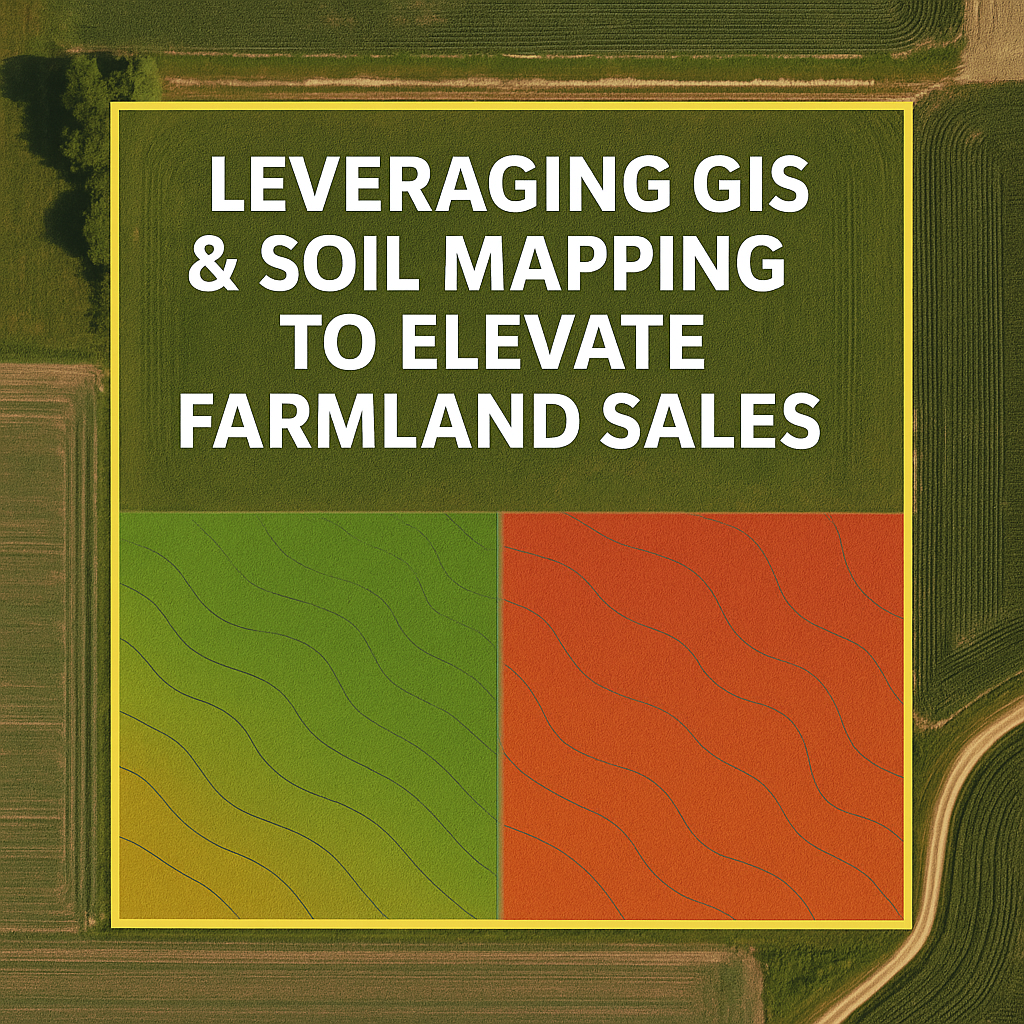
In today’s farmland market, buyers expect data-driven insights, transparency, and confidence in a property’s long-term potential. At Whitaker Marketing Group, we leverage GIS (Geographic Information Systems) and advanced soil mapping to showcase farmland in ways that go far beyond traditional listings. As a result, both buyers and sellers gain a clearer understanding of the land’s true value.
What is GIS & Digital Soil Mapping?
GIS is a system that captures, stores, and analyzes spatial data, allowing us to create layered maps that reveal important characteristics such as soil types, drainage, and topography. In other words, it provides a visual representation of how land performs. According to the USDA NRCS Soil Survey, GIS ools are becoming increasingly vital for evaluating agricultural land. Furthermore, Digital Soil Mapping (DSM) takes this process a step further by using models and remote sensing to predict soil properties across entire landscapes. Research published in the Frontiers in Soil Science Journal shows that DSM provides higher-resolution soil data that can improve both farm management and land valuation.
Benefits for Sellers & Buyers
1. Build Buyer Confidence with Clarity
GIS maps allow buyers to see soil fertility, productivity zones, and drainage patterns in one view—helping them understand a farm’s value quickly. For example, tools like EOS’s GIS in Agriculture show how producers already use this technology to make informed decisions. Consequently, farmland marketed with GIS data attracts more confident and qualified buyers.
2. Showcase Productivity and Land Value
Soil productivity often correlates directly with farmland pricing. The Iowa State University Extension notes that soil quality, drainage, and fertility remain leading factors in determining farmland value. Therefore, by highlighting these attributes through mapped visuals, sellers can demonstrate long-term return potential in a clear, compelling way.
3. Support Informed Pricing and Investment Decisions
GIS enables suitability analysis, which evaluates which areas are best suited for planting, conservation, or development. Because of this, buyers can make more data-driven investment decisions. The USDA Geospatial Data Gateway provides nationwide datasets that support this type of land-use planning and marketing. In turn, this ensures accuracy and trust throughout the transaction process.
4. Demonstrate Modern, Pecise Land Management
GIS is foundational to modern precision agriculture. The USDA Agricultural Research Service reports that precision tools enable GPS-guided planting and variable-rate applications—practices that boost efficiency and sustainability. As a result, farms utilizing these methods tend to achieve higher long-term performance and attract more investor interest.
5. Elevate Listings with Credibility and Detail
When listings incorporate data from trusted resources like the NRCS Web Soil Survey, buyers can verify soil types and productivity themselves. In addition, this transparency builds credibility and enhances confidence in both the land and the seller.
How Whitaker Marketing Group Uses GIS & Soil Mapping
1. Parcel Evaluation – We pull boundary data and overlay it with NRCS soil survey information.
2. Generate Contextual Maps – Layer visuals to show slope, drainage, and soil classifications.
3. Data-Backed Descriptions – Write listing narratives that explain soil productivity and management zones in clear language.
4. Advanced Insights – Use DSM to show predictive values like carbon content and water-holding capacity.
Final Thoughts
At Whitaker Marketing Group, mapping is more than a technical tool—it’s a storytelling resource. Ultimately, by combining GIS data, soil insights, and precision technology, we help sellers position their land for success while giving buyers the confidence to invest wisely.
515-996-5263 |✉️info@wmgauction.com